
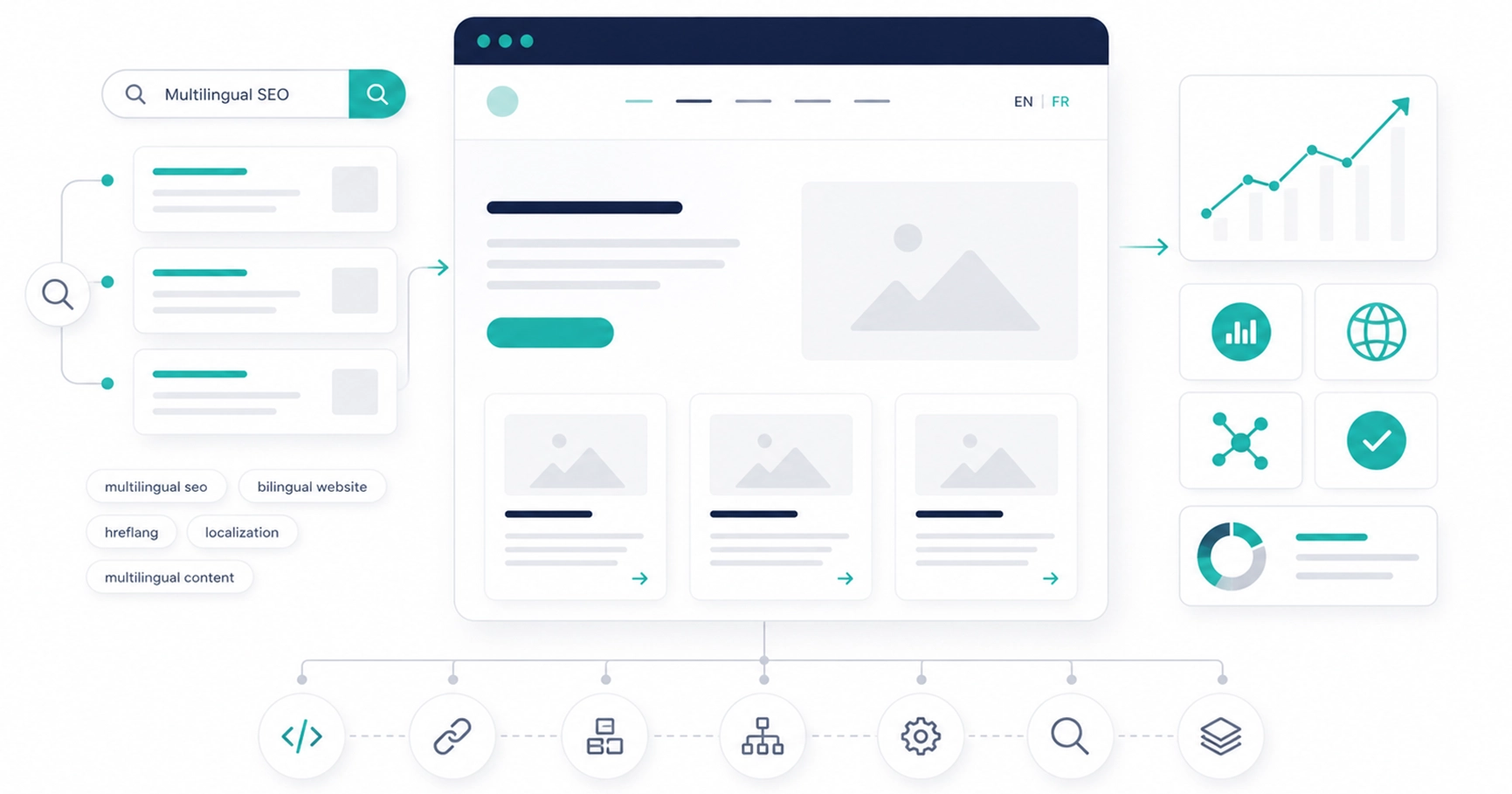
Multilingual SEO helps people find your website in their preferred language through search engines. It involves much more than translating content—it requires optimizing each language version so it matches how its audience searches while helping search engines understand the relationship between equivalent pages.
In this guide, you’ll learn how multilingual SEO works, how it differs from traditional and international SEO, and the best practices for improving your website’s visibility in multiple languages.
Multilingual SEO at a Glance
Multilingual SEO helps search engines understand, index, and display the most appropriate language version of a page for each audience.
- Research keywords independently for every language.
- Create useful, language-specific content that matches search intent.
- Organize translated pages under a clear and consistent URL structure.
- Connect equivalent pages using proper technical signals, including hreflang tags.
- Optimize titles, meta descriptions, headings, internal links, and calls to action for every language.
- Measure rankings, traffic, and conversions separately for each language version.
What Is Multilingual SEO?
Multilingual SEO is the practice of optimizing multiple language versions of a website so that search engines can understand, index, and display the most relevant page to users searching in each language. Rather than treating translated pages as simple copies, multilingual SEO ensures that every language version is optimized for its own audience.
For example, a Canadian business may have one service page in English and an equivalent page in French. Although both pages describe the same service, each should be optimized using the terminology, keywords, and search intent that best reflect how its target audience searches online.
A multilingual SEO strategy typically includes:
- Keyword research for every language.
- Language-specific SEO titles and meta descriptions.
- Localized headings and page content.
- Translated or localized URL slugs.
- Hreflang implementation.
- Canonical tag management.
- Language-specific internal linking.
- Technical crawling and indexing controls.
- Structured data in the appropriate language.
- Performance tracking by language and, where applicable, by region.
While multilingual SEO is built on the same principles as search engine optimization, those principles must be applied individually to every language version of a website. The goal is not simply to translate content, but to help each language version earn visibility in search results and provide the best possible experience for its intended audience.
How Is Multilingual SEO Different From Traditional SEO?
Traditional SEO and multilingual SEO share the same objective: helping a website become more visible in search results. Both rely on understanding search intent, creating valuable content, optimizing pages, improving website structure, and making it easy for search engines to crawl and index a website.
The difference is that multilingual SEO applies those same principles across multiple language versions of a website. Rather than optimizing a single set of pages, each language version must be researched, optimized, and maintained independently while remaining technically connected to its equivalents.
The comparison below highlights some of the key differences.
| Factor | Traditional SEO | Multilingual SEO |
|---|---|---|
| Target Audience | Optimizes a website for users searching in one primary language. | Optimizes a website for users searching in multiple languages. |
| Keyword Research | Researches keywords in a single language. | Researches keywords independently for each language to reflect local search behaviour. |
| Content Optimization | Optimizes one version of each page. | Optimizes every language version with its own content, headings, metadata, and calls to action. |
| Metadata | Uses one set of SEO titles and meta descriptions. | Creates language-specific SEO titles and meta descriptions for every page. |
| Website Structure | Typically has a simpler website structure. | Requires a clear language-specific URL structure and technical signals such as hreflang tags. |
| Internal Linking | Links related pages within a single language. | Maintains language-specific internal links while connecting equivalent pages through a language switcher. |
| Performance Tracking | Measures rankings, traffic, and conversions for one language. | Tracks rankings, traffic, and user engagement separately for each language version. |
Multilingual SEO is not a replacement for traditional SEO—it builds upon it. The same SEO best practices still apply, but they must be implemented consistently across every language version of a website. This requires additional planning, technical configuration, and ongoing optimization to ensure each audience receives the most relevant experience.
Multilingual SEO vs. International SEO
Multilingual SEO and international SEO are closely related, but they solve different problems. Although the terms are sometimes used interchangeably, they focus on different aspects of helping websites reach the right audience through search engines.
Multilingual SEO focuses on language. Its goal is to help people find the most appropriate version of a website based on the language they use when searching.
International SEO focuses on geographic targeting. Despite its name, it is primarily concerned with helping search engines understand which pages are intended for users in specific countries or regions. A website may target multiple countries that all speak the same language, or it may combine international SEO with multilingual SEO to reach different language audiences across multiple markets.
| Factor | Multilingual SEO | International SEO |
|---|---|---|
| Primary Focus | Optimizing content for multiple languages. | Optimizing content for different countries or regions. |
| Primary Signal | Language. | Country or region. |
| Target Audience | Users who search in different languages. | Users located in different geographic markets. |
| Keyword Strategy | Researches keywords independently for each language. | Adapts keywords to match regional search behaviour, terminology, and local search intent. |
| Website Structure | Uses language-specific URLs and translated or localized content. | May use country-code domains, regional subdirectories, subdomains, or country-specific versions of a website. |
| Typical Example | An English and French website serving customers across Canada. | Separate English websites targeting Canada, the United States, Australia, and the United Kingdom. |
Think of it this way: multilingual SEO answers “What language does my audience speak?”, while international SEO answers “Which country or region is my audience in?”.
A website can be multilingual without being international. For example, an English and French website may primarily serve customers within Canada.
Likewise, a website can be international without being multilingual. A company may create separate English websites for Canada, the United States, Australia, and the United Kingdom. Although every page is written in English, each version is optimized for a different country and its local search behaviour.
Many businesses benefit from both strategies. An international company may create language-specific content while also adapting that content for different countries and regions.
Businesses that serve customers in specific cities or regions can also benefit from local SEO. While multilingual SEO helps search engines understand the correct language version of your website, local SEO improves visibility for location-based searches and Google Maps, allowing businesses to reach nearby customers more effectively.
Example: A business targeting French-speaking customers in Quebec and France uses the same language, but each audience has different search behaviour, terminology, currency, regulations, and customer expectations. Even though both versions are written in French, they may require different keywords, localized content, and regional SEO strategies.
Why Multilingual SEO Matters
Publishing a website in multiple languages can make your content accessible to a wider audience, but translation alone does not guarantee visibility in search results. Without proper optimization, search engines may struggle to understand which language version should appear for a particular user, and potential customers may never discover your content.
Multilingual SEO helps bridge that gap by ensuring every language version of your website is optimized for its intended audience. It improves search visibility, creates a better user experience, and helps connect your business with people searching in their preferred language.
Reach Customers in Their Preferred Language
Most people prefer to research products, compare services, and make purchasing decisions in the language they use every day. Optimizing each language version independently increases the likelihood that users will discover your website through searches in their native or preferred language.
Improve Search Relevance
Search engines aim to deliver the most relevant results for every query. When each language version is optimized with its own keywords, metadata, and content, search engines can more confidently match users with the page that best fits their language and search intent.
Create a Better User Experience
A visitor who searches in French expects to arrive on a French page, not an English page that requires them to switch languages manually. Directing users to the appropriate language version creates a smoother experience, reduces frustration, and makes it easier for visitors to find the information they need.
Build Trust With Different Audiences
People are generally more comfortable engaging with a website that communicates clearly in their preferred language. Consistent navigation, forms, calls to action, and supporting content can help reinforce professionalism, credibility, and trust.
Support Growth in New Markets
As businesses expand into new regions or begin serving multilingual communities, multilingual SEO helps them reach new audiences without relying solely on paid advertising. A well-optimized multilingual website can attract qualified visitors from multiple language markets through organic search.
Why It Matters for Canadian Businesses
Canada is one of the clearest examples of where multilingual SEO can provide value. Many businesses serve both English- and French-speaking customers, particularly in regions such as Quebec, Ottawa–Gatineau, and New Brunswick. In bilingual markets like Montreal, businesses investing in web design in Montreal can improve their visibility by creating separate English and French pages that are optimized independently for each audience.
It’s also important to remember that English keywords cannot simply be translated into French. Search behaviour, terminology, and customer expectations often differ between languages, which is why keyword research, content optimization, and localization should be performed independently for each audience.
Note: Multilingual SEO can improve the visibility and usability of bilingual websites, but it should not be considered legal guidance. Businesses with questions about language laws or regulatory requirements should consult a qualified legal professional.
Translation Is Not the Same as Multilingual SEO
Translation and multilingual SEO work together, but they are not the same thing. Translation changes content from one language into another, while multilingual SEO ensures that translated or localized content can be discovered by the people it is intended to reach.
A page can be translated perfectly and still struggle to rank in search results if it isn’t optimized for the language, audience, and search intent of its users. Multilingual SEO focuses on making each language version visible, relevant, and useful to both search engines and visitors.
A translated page may still perform poorly if it contains:
- Keywords that people rarely use.
- SEO titles and meta descriptions left in the original language.
- Untranslated or confusing URL slugs.
- Headings that don’t match local search intent.
- Literal translations instead of natural terminology.
- Internal links that lead to pages in another language.
- Missing or incorrect hreflang tags.
- Calls to action that don’t resonate with the intended audience.
- Navigation, forms, or buttons that remain untranslated.
Translation answers: “What does this content say in another language?”
Multilingual SEO answers: “How can this page be optimized so the right audience can find it through search engines?”
Can AI Translation Be Good for SEO?
Yes. AI translation can be an effective way to create multilingual content, especially when combined with human review and a well-planned SEO strategy. Modern AI tools can significantly reduce the time and cost of translating websites while making multilingual SEO more accessible for businesses of all sizes.
However, AI translation alone does not guarantee good SEO results. Every language version should still be reviewed for keyword usage, search intent, terminology, formatting, readability, internal links, metadata, and calls to action. Search engines evaluate the overall quality and usefulness of a page—not whether it was written by a person or assisted by AI.
The goal is not simply to publish translated content. The goal is to create pages that feel natural to their audience, answer the user’s search intent, and provide a high-quality experience in every language.
How Does Multilingual SEO Work?
Multilingual SEO combines content, technical SEO, and user experience to help search engines understand the relationship between different language versions of a website. Rather than simply translating pages, every language version should be planned, optimized, and maintained as part of a complete SEO strategy.
Although every website is different, most multilingual SEO strategies follow these six stages:
- Choose your target languages and audiences. Identify the languages and markets your business genuinely serves rather than translating your website into as many languages as possible.
- Research keywords for each language. Every language should have its own keyword research because people often search using different words, phrases, and terminology.
- Create or localize your content. Translate or adapt each page so it feels natural to its intended audience while matching local search intent.
- Organize your website structure. Give every language version its own clear, crawlable URL and maintain a consistent website structure across all languages.
- Implement technical SEO. Configure language attributes, hreflang tags, canonical tags, XML sitemaps, and internal links so search engines understand how your language versions relate to one another.
- Monitor and improve performance. Track rankings, traffic, user engagement, and conversions for every language, then continue refining your content and technical SEO over time.
Each stage supports the next. Thorough keyword research cannot compensate for a poor website structure, and perfectly implemented hreflang tags cannot make up for low-quality or poorly localized content. Long-term success comes from treating multilingual SEO as an ongoing process rather than a one-time translation project.
What’s next? The following sections explore each stage in more detail, beginning with multilingual keyword research and content localization.
Multilingual Keyword Research
Keyword research is one of the most important parts of multilingual SEO. One of the biggest mistakes businesses make is researching keywords in one language and translating them word for word into another. Although the translation may be grammatically correct, it doesn’t necessarily reflect how people actually search.
Every language has its own vocabulary, search habits, and cultural nuances. People looking for the same product or service may use completely different words depending on their language, location, and level of familiarity with the topic.
Search behaviour can vary because of:
- Regional terminology and dialects.
- Formal versus informal language.
- Industry-specific vocabulary.
- Cultural preferences and local expressions.
- Differences in search intent.
- English words commonly adopted into another language.
- Local laws, institutions, and business practices.
- The way products or services are marketed in different regions.
Start With the Topic, Not the Translation
Instead of translating an English keyword directly, start by identifying the topic your page should cover. Then research how people naturally search for that topic in the target language.
For example, a service that has one common English name may have several possible French translations. While each translation may be technically correct, only one may be widely used by potential customers. Choosing the wrong phrase can make it much harder for people to discover your content.
Research Every Language Independently
Treat every language as its own search environment. Review keyword suggestions, related searches, competing websites, and search results independently rather than assuming they will mirror the original language.
This often reveals differences in terminology, keyword popularity, and user expectations that would be missed through direct translation alone.
Understand Search Intent
Two keywords may appear to have the same meaning while producing completely different search results. One phrase might return educational articles, while another primarily displays service providers, product pages, local businesses, or videos.
Before choosing a target keyword, review the search results to understand what users expect to find. Your page should match that intent as closely as possible.
Create a Language-Specific Keyword Map
Once you’ve identified the best keywords for each language, assign them to specific pages on your website. A keyword map helps prevent multiple pages from competing for the same search intent while making it easier to plan titles, headings, internal links, and future content.
Key takeaway: Translate the meaning of the topic—not the keyword itself. Research every language independently to discover the words and phrases your audience actually uses when searching.
Content Translation vs. Content Localization
Translation and localization are closely related, but they are not the same thing. Translation changes the language of your content, while localization adapts that content so it feels natural and relevant to the audience reading it.
Translation focuses on preserving the original meaning as accurately as possible.
Localization goes a step further by adjusting the content to reflect the language, culture, expectations, and search behaviour of a specific audience or region.
Depending on the page, localization may include changes to:
- Terminology and regional vocabulary.
- Currency and pricing.
- Measurements and units.
- Date and time formats.
- Examples and case studies.
- Locations and geographic references.
- Laws, regulations, or industry standards.
- Product or service availability.
- Tone, style, and level of formality.
- Calls to action.
- Customer expectations and buying behaviour.
Not Every Page Needs the Same Level of Localization
The amount of localization required depends on the purpose of the page. A technical guide or educational article may require only minor adjustments, while a service page or product page may need significant changes to reflect local terminology, offers, regulations, and customer expectations.
The goal isn’t to make every language version identical. The goal is to create content that feels natural, useful, and trustworthy for the audience it is intended to serve.
Key takeaway: Translation helps people understand your content. Localization helps them connect with it.
Choosing the Right Multilingual URL Structure
Every language version of your website should have its own permanent, crawlable URL. Separate URLs allow search engines to index each language independently, help users share and bookmark the correct page, and make it easier to measure performance for each language.
There are several ways to organize a multilingual website. The best choice depends on your platform, target audience, and long-term maintenance strategy.
Language Subdirectories
example.com/en/
example.com/fr/
Subdirectories are one of the most common and widely recommended approaches for multilingual websites. They keep all language versions under a single domain, making the website easier to manage while allowing search engines to clearly identify each language.
For example:
example.com/en/services/
example.com/fr/services/
For many businesses, subdirectories provide a good balance between SEO, simplicity, and long-term maintenance.
Language Subdomains
en.example.com
fr.example.com
Subdomains separate each language into its own section of the website. This approach can work well for larger organizations or websites that require independent hosting, administration, or technical configurations for each language.
However, subdomains generally require more ongoing management than subdirectories and may be treated more independently by search engines in certain situations.
Country-Code Top-Level Domains (ccTLDs)
example.ca
example.fr
example.de
Country-code domains are typically used when targeting different countries rather than simply offering multiple languages. They send a strong geographic signal but also require maintaining separate domains, which increases administrative and SEO complexity.
URL Parameters
example.com/page/?lang=frSome websites identify language versions using URL parameters. While this approach can work, it is generally less user-friendly and may make website management more difficult. For most multilingual websites, dedicated language URLs are a clearer and more scalable solution.
Should URL Slugs Be Translated?
Whenever practical, descriptive URL slugs should be translated along with the rest of the page. This creates cleaner URLs for users and makes each language version feel more natural.
example.com/en/website-design/
example.com/fr/conception-de-sites-web/
Although translated slugs can improve usability, consistency is more important than choosing a particular format. Once a URL structure has been established, avoid changing it unnecessarily, as doing so can create redirects and temporarily affect search performance.
Recommendation: For most multilingual websites, language subdirectories combined with translated URL slugs provide a simple, scalable, and SEO-friendly structure that’s easy to manage over time.
What Are Hreflang Tags?
When a website contains multiple versions of the same page in different languages or for different regions, search engines need a way to understand how those pages are related. Hreflang tags provide that information.
Hreflang annotations tell search engines that different URLs represent equivalent content for different language or regional audiences. This helps search engines understand which version of a page is intended for each audience, making it more likely that users see the most appropriate version in search results.
For example, a website may have separate English and French versions of the same service page:
<link rel="alternate" hreflang="en-ca" href="https://example.com/en/service/" />
<link rel="alternate" hreflang="fr-ca" href="https://example.com/fr/service/" />
These annotations tell search engines that both pages cover the same topic but are intended for different language audiences.
What Hreflang Helps With
- Connecting equivalent pages written in different languages.
- Helping search engines display the most appropriate language or regional version.
- Distinguishing regional variations of the same language, such as English for Canada and English for the United Kingdom.
- Reducing the likelihood that users are shown the wrong language version.
What Hreflang Does Not Do
- It does not improve rankings by itself.
- It does not translate content.
- It does not replace high-quality content or keyword research.
- It does not automatically redirect visitors.
- It does not replace canonical tags.
Hreflang vs. Canonical Tags
Hreflang and canonical tags serve different purposes and are often used together. Hreflang identifies equivalent pages intended for different languages or regions, while canonical tags indicate which version of duplicate or substantially similar content should be treated as the preferred page for indexing.
On a properly configured multilingual website, each language version will usually have a self-referencing canonical tag, while hreflang tags connect all equivalent language or regional versions.
Do Translated Pages Cause Duplicate Content?
Businesses sometimes worry that translated pages will be treated as duplicate content because they communicate similar information. In most cases, properly translated or localized pages are intended for different audiences and are not considered duplicate content simply because they cover the same topic.
Duplicate content issues are more likely to occur when:
- Multiple URLs contain identical content in the same language.
- Every translated page points its canonical tag to the original language version.
- Language parameters create multiple indexable versions of the same page.
- Some language versions are incomplete or only partially translated.
- Search engines cannot identify the relationship between language versions.
- Plugins or redirects generate additional indexable URLs.
Most duplicate content issues on multilingual websites are caused by configuration problems rather than by publishing content in multiple languages.
Implement Hreflang Consistently
For hreflang to work correctly, equivalent language versions should reference one another, use valid language or regional codes, and point to indexable URLs. Missing or inconsistent annotations can make it more difficult for search engines to understand the relationship between multilingual pages.
Each hreflang set should also include a reference to the current page itself. For example, the English page should reference both the English and French versions, and the French page should do the same.
Key takeaway: Hreflang does not improve rankings on its own. Its purpose is to help search engines understand the relationship between language or regional versions and show the most appropriate page to the right audience.
On-Page SEO for Every Language Version
Every language version of a page should be treated as a complete page in its own right. Although different language versions may cover the same topic, each one should be reviewed and optimized independently rather than copied directly from the original language.
In addition to translating the main content, review every important on-page SEO element, including:
- SEO title.
- Meta description.
- URL slug.
- H1 heading.
- H2 and H3 headings.
- Body content.
- Image alt text where appropriate.
- Internal links.
- Button labels.
- Forms and confirmation messages.
- Calls to action.
- Structured data.
- Breadcrumbs.
Optimize for the Language, Not Just the Translation
Content that works well in one language may require adjustments in another. A page title that fits comfortably in English may become too long when translated, while a call to action that sounds natural in one language may feel awkward or overly literal in another.
Every element should be reviewed in context to ensure it reads naturally, supports the target keyword, and provides a good user experience.
Language Version Checklist
- Does the page target a genuine search topic?
- Is the primary keyword natural for this language?
- Are all visible page elements translated?
- Do internal links stay within the same language?
- Does the page have a clear SEO title and meta description?
- Does the call to action make sense for this audience?
Technical SEO for Multilingual Websites
Multilingual websites introduce additional technical considerations because every language version must remain accessible, indexable, and connected correctly. Small configuration errors can affect many pages when the same templates, plugins, or settings are used across multiple languages.
Technical SEO helps search engines crawl each language version, understand how the pages relate to one another, and deliver the most appropriate content to users.
Crawlable Language URLs
Every language version should be accessible through a permanent URL and standard HTML links. Important content should not depend entirely on cookies, browser settings, language detection, or scripts that search engines may not interpret consistently.
Search engines should be able to reach each language version by following links from the website, including the navigation, language switcher, internal links, and XML sitemap.
Internal Linking Between Language Versions
Internal links help visitors navigate the website and help search engines understand how pages relate to one another. On a multilingual website, they should normally maintain a consistent language experience.
- An English article should link to the English version of a related service page.
- A French article should link to the French version of that service page.
- Related articles should link to one another within the same language.
- The language switcher should connect equivalent pages whenever possible.
- Links leading to content in another language should clearly identify the destination language.
Avoid directing every language-switcher selection to the homepage. Someone viewing a specific article or service page will usually expect the switcher to open the equivalent version of that same page.
Internal links should also use clear, descriptive anchor text. Instead of relying on vague phrases such as “click here,” describe the topic or destination naturally.
XML Sitemaps
Every language page intended to appear in search results should be included in an XML sitemap. Multilingual and SEO plugins can often generate these sitemaps automatically, but the output should still be reviewed.
Check that valid language pages are included, redirected or non-indexable URLs are excluded, and sitemap entries point to the preferred version of each page.
HTML Language Attributes
The HTML language attribute should identify the primary language of each page. For example:
<html lang="en-CA">
<html lang="fr-CA">
This attribute supports accessibility tools, browsers, and other software in interpreting the language of the page correctly. It complements hreflang tags but does not replace them.
Indexability
Check that translated or localized pages are not accidentally blocked from search engines. Common causes include:
- Noindex tags.
- Robots.txt restrictions.
- Password protection.
- Incorrect canonical tags.
- Plugin settings that hide translated pages.
- Redirects pointing to the wrong language version.
Each page intended to rank should return a successful status code, contain indexable content, and use the correct canonical URL.
Mobile Usability
Translations can change the length of headings, buttons, menus, labels, and form fields. A layout that works well in one language may wrap, overflow, or become difficult to use in another.
Test every language version on mobile devices and review navigation menus, buttons, tables, forms, popups, and language switchers at different screen sizes.
Page Speed
Images, scripts, multilingual plugins, language switchers, and duplicated page-builder assets can affect performance. Adding more language versions should not result in an unnecessarily slow website.
Use optimized images, caching, efficient hosting, and only the scripts and plugins the website genuinely needs. Performance should be tested across multiple language versions rather than only on the original page.
Structured Data
Where structured data is used, visible names, descriptions, questions, answers, and other relevant properties should match the language of the page.
For example, a French FAQ page should not contain English questions and answers in its structured data. Schema markup should accurately reflect the visible content users can read on that page.
Automatic Language Redirects
Automatic language redirects should be implemented carefully. Redirecting users solely based on their browser language or location can prevent them from accessing the version they prefer and may make crawling more difficult.
Visitors should always be able to change languages manually, and search engines should be able to access every valid language URL without being forced to another version.
Multilingual SEO for WordPress and WPML
WordPress multilingual plugins can provide much of the technical infrastructure needed to create and manage a multilingual website. Depending on the plugin and configuration, they may help manage:
- Separate pages for each language.
- Language-specific URLs.
- Relationships between translated pages.
- Menus and navigation.
- Language switchers.
- Translated media information.
- SEO titles and meta descriptions.
- XML sitemaps.
- Hreflang annotations.
WPML is one of the most widely used plugins for creating multilingual WordPress websites. When configured alongside a compatible SEO plugin, it can help manage translated pages, language-specific metadata, XML sitemaps, and hreflang annotations.
However, a multilingual plugin does not replace an SEO strategy. It cannot independently determine:
- Which keywords potential customers actually use.
- Whether a translation matches search intent.
- Which pages should be translated or created.
- Whether the content is useful and accurate.
- Which internal links are most relevant.
- Whether the overall customer experience is effective.
A multilingual plugin provides the technical foundation, but it does not replace an SEO strategy. Keyword research, content planning, translation review, technical testing, and ongoing optimization still require careful attention to achieve strong search visibility.
Technical SEO Checklist
- Does every language version have a permanent, crawlable URL?
- Can search engines reach each version through standard links?
- Do internal links remain within the correct language?
- Does the language switcher connect equivalent pages?
- Are indexable pages included in the XML sitemap?
- Is the HTML language attribute correct?
- Are translated pages free from accidental noindex rules or incorrect canonical tags?
- Does every language version work properly on mobile devices?
- Does structured data match the visible language of the page?
Common Multilingual SEO Mistakes
Many multilingual SEO problems are caused by small strategic or technical mistakes repeated across multiple language versions. Identifying these issues early can help improve search visibility, user experience, and long-term website performance.
1. Translating Keywords Word for Word
A direct translation may be grammatically correct without matching the words people actually use in search engines. Research keywords independently for every language and optimize for search intent rather than literal translations.
2. Leaving Metadata in the Original Language
Every language version should have its own SEO title and meta description. Leaving metadata untranslated can reduce relevance, create inconsistent search snippets, and discourage users from clicking.
3. Publishing Automatic Translation Without Review
AI and machine translation can significantly speed up content creation, but every page should still be reviewed for meaning, terminology, grammar, formatting, readability, and search intent before it is published.
4. Sending Every Language-Switcher Link to the Homepage
A language switcher should normally connect equivalent pages. Someone reading a specific article or service page should be taken to the translated version of that page rather than the homepage.
5. Using Incorrect Hreflang Codes
Invalid language codes, broken URLs, missing return references, or inconsistent hreflang annotations can make it more difficult for search engines to understand the relationship between language versions.
6. Canonicalizing Every Language to the Original Page
Pointing every translated page to the original language version with a canonical tag may prevent alternate language pages from being indexed correctly. In most cases, each language version should use a self-referencing canonical tag.
7. Translating Only Part of a Page
A page with translated content but untranslated menus, buttons, forms, breadcrumbs, or confirmation messages can feel incomplete and unprofessional. Review the entire user experience, not just the main body content.
8. Using Flags as the Only Language Selector
Flags represent countries, not languages. Because many languages are spoken in multiple countries, clear labels such as “English” and “Français” are generally more accurate and easier for visitors to understand.
9. Ignoring Regional Search Intent
The same language can vary between countries and regions. For example, terminology commonly used in France may differ from the terms people search for in Quebec, Belgium, or Switzerland.
10. Measuring All Languages Together
Looking only at total organic traffic can hide important differences between language versions. Measure performance separately for each language by monitoring impressions, clicks, rankings, queries, and conversions.
Key takeaway: Most multilingual SEO mistakes happen when language versions are treated as simple copies. Every language version should have its own keyword research, optimization, technical review, and ongoing performance monitoring.
Building a Multilingual SEO Strategy
A successful multilingual SEO strategy should be planned before translating large numbers of pages. Taking the time to define your languages, content, website structure, and technical implementation early can help prevent costly mistakes later.
The following framework provides a practical approach to planning, launching, and maintaining a multilingual website.
Step 1: Identify Your Target Languages and Markets
Choose languages based on customer demand, business goals, geographic markets, and your ability to support those audiences. Avoid adding languages simply because translation technology makes it easy.
Determine whether you are targeting a language, a country, a region, or a combination of all three. This decision will influence your keyword research, content, URL structure, and technical SEO.
Step 2: Audit Your Existing Website
Review your current content, website structure, indexing, internal links, page speed, mobile usability, and overall technical health. Fixing existing SEO issues before expanding into multiple languages helps prevent those problems from being duplicated.
Step 3: Research Keywords for Every Language
Research how each audience searches for your products, services, and topics. Compare terminology, search intent, regional differences, competing pages, and the types of results that appear for important queries.
Never assume that a successful keyword in one language has an equivalent keyword with the same search volume or intent in another.
Step 4: Create a Keyword and Content Map
Assign target keywords and topics to individual pages in each language. Decide which pages should exist in every language, which require localization, and whether certain audiences need unique content.
A content map also helps prevent multiple pages from competing for the same search intent.
Step 5: Plan Your Website Structure
Choose whether your website will use language subdirectories, subdomains, or country-code domains before publishing large amounts of content. Select a structure that is scalable, easy to maintain, and easy for search engines to crawl.
Plan your menus, language switcher, internal linking, translated URL slugs, and relationships between equivalent pages at the same time.
Step 6: Translate, Localize, and Optimize Every Page
Create content that reflects your audience’s language, terminology, questions, and expectations. Review AI-assisted or machine-generated translations before publishing.
Optimize SEO titles, meta descriptions, headings, URLs, body content, image alt text, internal links, calls to action, forms, and structured data independently for every language version.
Step 7: Implement and Test the Technical SEO
Configure hreflang tags, self-referencing canonical tags, HTML language attributes, XML sitemaps, and indexability settings. Confirm that equivalent pages reference one another correctly and that search engines can crawl every language version.
Test menus, language switchers, forms, buttons, breadcrumbs, mobile layouts, confirmation messages, and internal links in every language before launching.
Step 8: Monitor, Measure, and Improve
Track impressions, clicks, rankings, queries, engagement, leads, and conversions separately for each language and target market. Search behaviour changes over time, competitors publish new content, and technical issues can appear after website updates.
Use performance data to improve underperforming pages, identify new content opportunities, strengthen internal linking, and continue refining your multilingual SEO strategy.
Key takeaway: Multilingual SEO is not a one-time translation project. It is an ongoing process of research, localization, technical optimization, testing, and continuous improvement.
FAQs About Multilingual SEO
What is multilingual SEO and how does it work?
Multilingual SEO is the process of optimizing separate language versions of a website so that search engines can understand, index, and display the most appropriate version to people searching in each language.
Is multilingual SEO the same as international SEO?
No. Multilingual SEO focuses primarily on reaching people who search in different languages, while international SEO focuses on reaching people in different countries or regions. Many websites require both strategies.
Do translated pages need separate SEO optimization?
Yes. Each language version should be reviewed separately for keyword research, search intent, page titles, meta descriptions, headings, internal links, URL structure, calls to action, and technical SEO.
Does multilingual content create duplicate-content problems?
Properly implemented translations are not automatically considered duplicate content because they serve different language audiences. However, incorrect canonical tags, duplicate URLs, partially translated pages, or conflicting technical signals can create indexing problems.
Are hreflang tags required for multilingual websites?
Hreflang tags are not required for every multilingual website, but they are often recommended when equivalent pages target different languages or regional audiences. They help search engines understand the relationship between those pages and display the most appropriate version in search results.
Can AI be used to translate content for multilingual SEO?
AI can make translation faster and more efficient, but every page should still be reviewed for accuracy, terminology, context, formatting, natural language, and search intent before it is published.
Should multilingual pages use translated URL slugs?
Translated, descriptive URL slugs are often easier for users and search engines to understand. However, the best approach depends on your website platform, target markets, existing URL structure, and long-term maintenance strategy.
How many languages should a website target?
A website should target languages that correspond to a real audience the business can serve. It is generally better to maintain a smaller number of complete, high-quality language versions than to publish many languages with incomplete or outdated content.
How do you measure multilingual SEO performance?
Multilingual SEO should be measured separately for each language whenever possible. Useful metrics include organic impressions, clicks, keyword rankings, indexed pages, engagement, conversions, and qualified leads. Google Search Console and analytics platforms can help monitor performance by language, page, country, and device. A smaller language audience may generate less traffic while still producing valuable customers or leads.
How long does multilingual SEO take?
There is no guaranteed timeline for multilingual SEO. Results depend on factors such as website authority, competition, content quality, technical implementation, and the number of languages being targeted. While technical improvements can often be completed quickly, building long-term organic visibility usually requires ongoing optimization, content improvements, and performance monitoring.
Does every website need multilingual SEO?
No. Multilingual SEO is most valuable for businesses that genuinely serve customers who search in multiple languages. If a business cannot support those customers or maintain accurate multilingual content, focusing on a single language is often a better long-term strategy than publishing incomplete or outdated translations.
Multilingual SEO in Canada
Canada is one of the clearest examples of where multilingual SEO can provide value. English- and French-speaking customers often use different terminology, search queries, and buying language, even when searching for the same product or service. Each language version should therefore be researched and optimized independently.
Businesses operating in Quebec should also be aware that language requirements may apply in certain situations. Questions about legal compliance should always be reviewed with a qualified legal professional.
To learn more, read our guide on Bill 96 and Business Websites: What Quebec Businesses Should Know.
If you’re planning an English and French website, you can also explore our Bilingual Website Design services.
Ready to Improve Your Multilingual SEO?
Building a multilingual website is only the first step. To reach customers in multiple languages, your website also needs the right keyword strategy, technical SEO, content optimization, and ongoing improvements.
We help Canadian businesses improve the visibility of their English and French websites through practical multilingual SEO strategies designed to attract the right audience and generate more qualified leads.